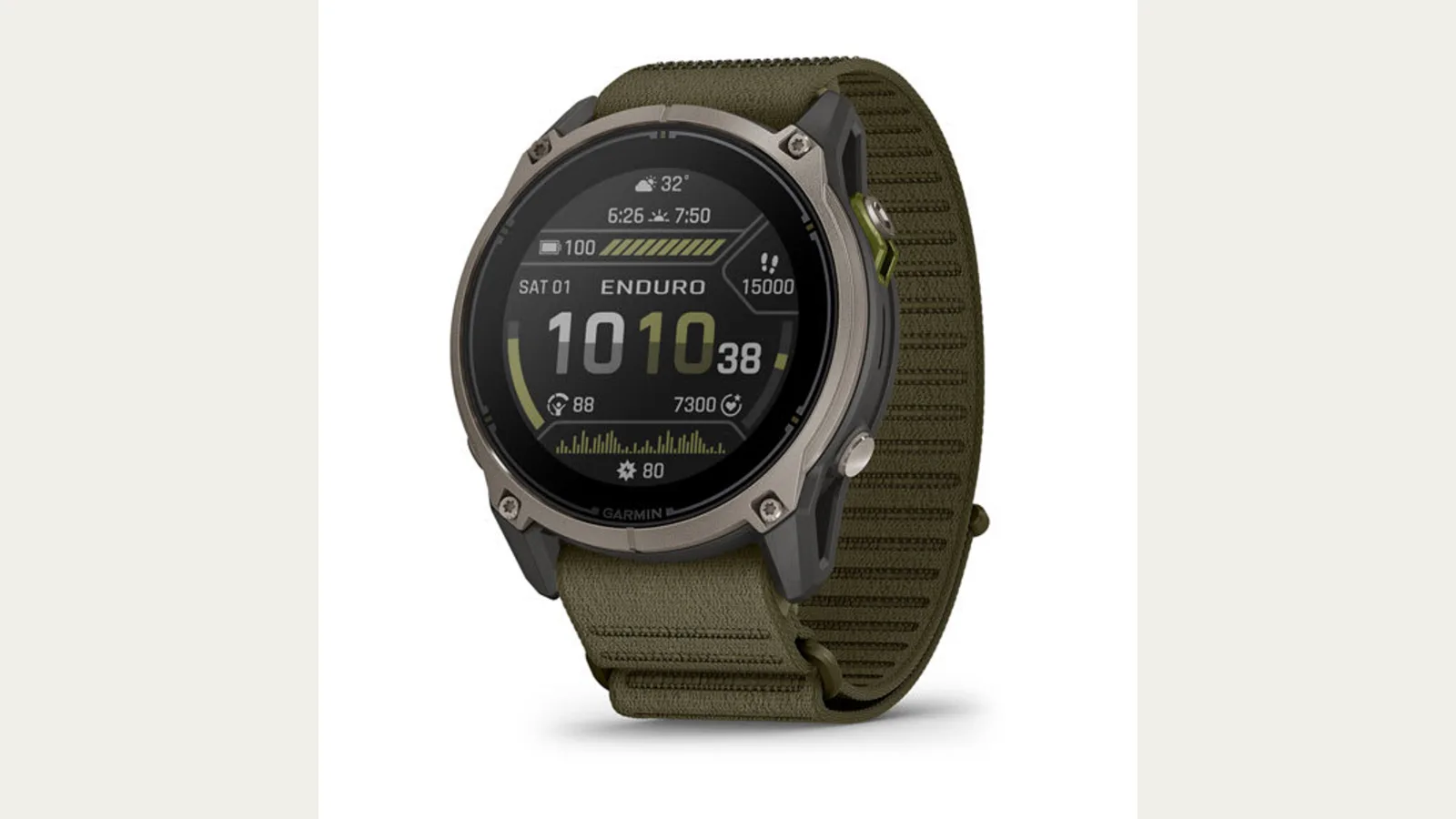
Featured image: Garmin
The current Garmin Enduro is the Enduro 4, announced on 6 October 2026: a 51 mm solar GPS watch with a fiber-reinforced polymer case, titanium bezel and a battery rated for up to 90 days in smartwatch mode. It is Garmin’s battery-first answer to the Fenix line, built for ultrarunners, long-distance hikers and anyone who hates charging.
Quick answer The Garmin Enduro 4 costs about $900 and is the right pick if your priority is a watch that survives multi-day efforts with maps, a flashlight and solar top-ups. If you do not need the newest software and extra storage, the Enduro 3 is now about $100 cheaper with the same headline battery claims. If you have small wrists or want an AMOLED screen, look elsewhere.
Who the Garmin Enduro is for
The Enduro line exists for one reason: endurance. Garmin first launched it in 2021 as a watch “for ultrarunners”, and every generation since has kept that brief, trading a few of the Fenix’s frills for a lighter body and a much longer battery.
It suits people who record efforts that run past a full day: 100-mile races, fastest-known-time attempts, multi-day treks and bikepacking. It is also a sensible daily watch for anyone who wants to charge it a few times a year rather than a few times a week.
It is less obviously right for short-distance runners, swimmers or people with slim wrists. There is only one case size, 51 mm, and the screen is a transflective MIP display rather than the brighter AMOLED panels found on some other Garmins.
Garmin Enduro 4: key specs
The Enduro 4 keeps the shape and size of the Enduro 3 and changes the internals and software. Garmin’s launch release lists 64 GB of storage (double the previous watch), 50 percent more RAM, and a new fabric band. The table below compares it with the Enduro 3, which Garmin still sells as a previous model.
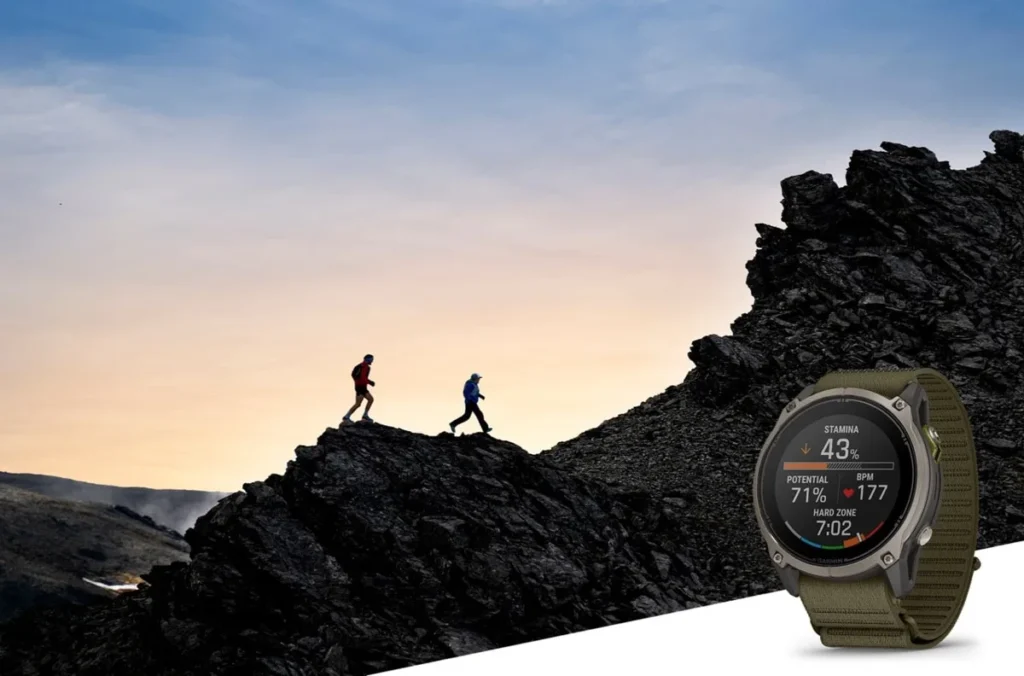
| Spec | Garmin Enduro 4 | Garmin Enduro 3 |
|---|---|---|
| Case size | 51 mm | 51 mm (about 15.7 mm thick) |
| Case and lens | Fiber-reinforced polymer, titanium bezel, Power Sapphire solar lens | Fiber-reinforced polymer, titanium bezel, solar lens |
| Display | 1.4 in MIP, solar | 1.4 in MIP, solar |
| Weight | 66 g with ComfortFit fabric band | 63 g with silicone band |
| Battery (smartwatch) | Up to 90 days with solar | Up to 90 days with solar |
| Battery (GPS) | Up to 320 hours with solar, extended battery mode | Up to 320 hours with solar |
| Storage | 64 GB | 32 GB |
| Water resistance | 10 ATM | 10 ATM |
| Flashlight | LED, white and red | LED |
| Approx. price | $899.99 retail | About $800 now ($899 at launch) |
Where to buy
Compare the same watch on both sites: eBay for pre-owned and vintage pieces, Amazon for new stock.
Garmin Enduro 4
Garmin Enduro 3 Alternative
COROS VERTIX 2S Alternative
Prices and availability change; check the listing before you buy.
Battery life: what the numbers really mean
Garmin’s headline figures are the 90 days in smartwatch mode and 320 hours of GPS tracking. Both assume solar charging, with the smartwatch figure based on about three hours a day outdoors in bright light and the GPS figure on continuous strong sun. Treat them as best cases.
Without solar help, the picture is more modest. Garmin and reviewers quote around 36 days for the Enduro 3 in everyday use. One third-party guide lists roughly 120 hours in Extended Battery mode and 60 hours in Max Accuracy mode for the Enduro 4, which is a more useful planning number for a race that starts before dawn.
The Enduro 4 splits GPS use into two modes. Max Accuracy runs the full feature set for shorter efforts, while Max Battery pares things back for ultra-distance recording. Choosing between them is the main battery decision you will make on the day.
Strengths and trade-offs
What the Enduro does well
Battery is the obvious win. In his review of the Enduro 2, DC Rainmaker covered an eight-day, 170 km trek on a single charge, and the line has only gained solar efficiency since. TechRadar called the Enduro 3’s endurance exceptional and its mapping among the strongest around.
Navigation is the second strength. Built-in routable maps, ClimbPro and trail-specific features come over from the Fenix family. The Enduro 4 adds a Perspective View of terrain ahead, and Garmin says map panning is about 30 percent faster than on the Enduro 3 thanks to the extra RAM.
It is also light for its size. At 63 to 66 g, it is on the light side for a 51 mm sports watch, which matters at hour 30 of a race. The built-in flashlight, with a red mode, is a genuinely useful piece of kit for night sections.
Where it falls short
Size is the first catch. A 51 mm case sits large on slim wrists, and TechRadar noted the same about the Enduro 3. There is no smaller option.
The second is price. At about $900 it is expensive, even if it undercuts the top Fenix models. The Enduro 3 lacks the speaker and microphone features that arrived on the Fenix 8, and TechRadar reported that its optical heart rate sensor struggled at high intensity, as wrist sensors often do.
Software bugs have also surfaced. DC Rainmaker found that pausing an activity over several days with “Resume Later” disrupted training metrics on the Enduro 2, and some GPX courses triggered a point limit that stripped turn prompts. Those reviews cover earlier generations, so check current user reports before relying on a multi-day workflow.
New training features on the Enduro 4
Garmin’s release lists grade-adjusted, pace-based workout targets, grade-adjusted rolling pace, stamina zones and a stamina curve. A feature called Garmin Epic groups activities across days or weeks in Garmin Connect, which suits stage races and multi-day adventures.
There are also new rowing and rucking profiles, and more than 100 activity profiles in total. These are Garmin’s claims from the launch; independent long-term reviews of the Enduro 4 were still thin at the time of writing.
Which version to buy
Buy the Enduro 4 if you want the newest software, 64 GB for maps and music, and the ComfortFit fabric band that Garmin says adjusts quickly. At $899.99 it costs the same as the Enduro 3 did at launch.
Buy the Enduro 3 if you want the same case, display, sensors and headline battery claims for about $100 less. Its 32 GB is still plenty for most map regions, and it works with the same straps. It is the value choice while stock lasts.
Skip the Enduro 2 and the original unless you find one cheap. They have less storage and, according to reviewers, less efficient solar charging than the later models. Prices on older stock vary widely, so compare against the Enduro 3.
Who wears the Garmin Enduro
Garmin’s Enduro 4 launch release names no ultrarunner ambassadors, so there is no confirmed wearer for the latest model. The earlier generations have documented users.

Gabe Joyes, a mountain runner Garmin lists as a Garmin Pro, wrote on Garmin’s blog in May 2021 about using the original Enduro on a 47-hour fastest-known-time run. He praised its low weight and solar charging.
British ultrarunner Jake Catterall used an Enduro 2 in 2024 while running the new red route of the Via Alpina, about 1,200 miles over 35 days. He told Advnture that its GPX maps saved him 40 to 50 minutes a day of navigation, and that he had a crew and a van to charge it overnight.
Alternatives to the Garmin Enduro
Within Garmin, the Fenix range offers smaller cases and AMOLED screens at the cost of battery life. For a broader view of the lineup, see our guide to the best Garmin watch, and if the Enduro is overkill, the Garmin Instinct 3 is a cheaper rugged option.
Among rivals, the Coros Vertix 2S is the closest endurance competitor. A buying guide updated in October 2026 lists it at about $699 with up to 118 hours of standard GPS. The Suunto Vertical 2, at about $599, offers a flashlight and maps but only around 65 hours in its best-accuracy mode.
If you are weighing Garmin against a mainstream smartwatch for all-round use, our comparison of Garmin vs Apple Watch covers the trade-offs in more detail.
FAQ
What is the newest Garmin Enduro?
The Enduro 4, announced on 6 October 2026 at $899.99. It follows the Enduro 3, which launched in 2024 and is now sold as a previous model at a lower price.
How long does the Garmin Enduro 4 battery last?
Garmin claims up to 90 days in smartwatch mode and up to 320 hours of GPS tracking, both with solar charging in strong light. Without solar, expect around 36 days of everyday use and far fewer GPS hours, depending on the mode you pick.
Is the Garmin Enduro worth it over the Fenix?
It is worth it if battery life and low weight matter more than a smaller case or an AMOLED screen. The Enduro costs less than the top Fenix models and lasts much longer between charges, but it comes in only one size.
Is the Garmin Enduro good for everyday wear?
Yes, if you are comfortable with a 51 mm watch. At 66 g it is light for its size and the battery means you rarely charge it. Slim wrists may find it bulky, and there is no smaller version.
Should I buy the Enduro 3 or Enduro 4?
The Enduro 4 adds 64 GB of storage, more RAM, faster maps and new training features. The Enduro 3 has the same case and headline battery claims for roughly $100 less, so it is the better value if you do not need those extras.
Does the Garmin Enduro have maps?
Yes. The Enduro line has built-in routable maps with trail navigation, and the Enduro 4 adds a Perspective View and faster map panning. Storage is 64 GB on the Enduro 4 and 32 GB on the Enduro 3.
Sources
- Garmin: Enduro 4 smartwatch redefines ultraperformance
- TechRadar: Garmin Enduro 3 Review
- DC Rainmaker: Garmin Enduro review
- Garmin Blog: Five Reasons Gabe Joyes Loves Garmin’s Enduro
- Advnture: Why ultra runner Jake Catterall loves the Enduro 2
- Multiday Running: Best GPS watches for ultrarunning