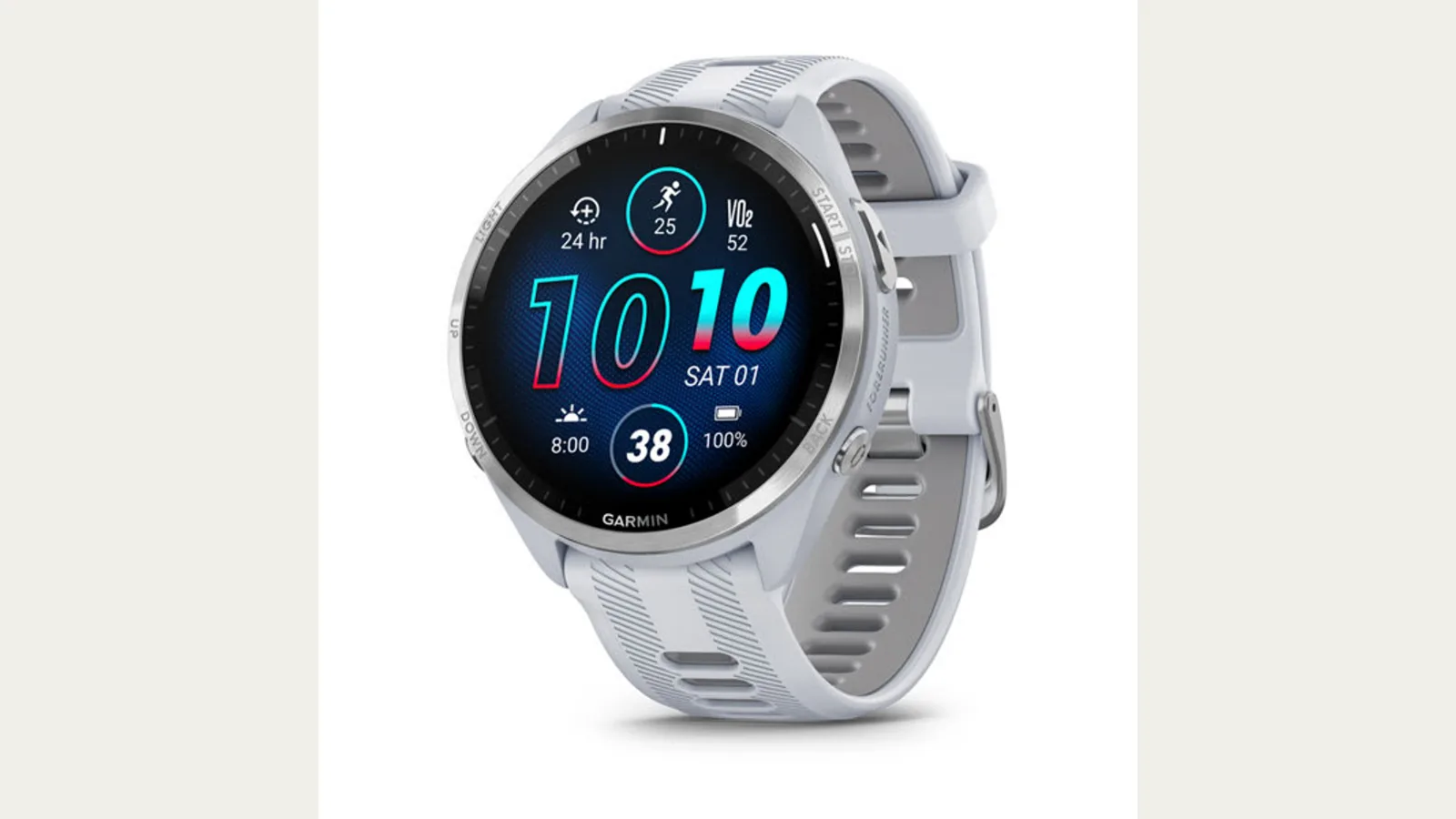
Featured image: Garmin
For most runners, the Garmin Forerunner 265 is the better buy: it has the same AMOLED screen type, multi-band GPS and core training metrics as the Forerunner 965 for $150 less. Pick the 965 only if you need full on-watch maps, much longer battery life or its extra endurance features.
Quick answer The Forerunner 265 ($449.99 list) and Forerunner 965 ($599.99 list) both came out in March 2023 and share most of their running smarts. The 965 adds full-color maps with turn-by-turn routing, 32 GB of storage, a titanium bezel, a bigger 1.4-inch screen and roughly 50 percent more battery (31 vs. 20 hours of GPS). If you run roads and follow plans, the 265 is enough. If you race ultras, run unfamiliar trails or ride with power meters, the 965 earns its premium.
The verdict first
These two watches are siblings, not rivals. Garmin launched them together and built them on the same platform, so the daily experience of checking your Training Readiness, following a structured workout or reviewing HRV Status overnight is nearly identical. The difference is what happens when you leave familiar ground or stay out for a long time.
The Forerunner 265 is the smart default for road runners, half-marathon and marathon trainees, and anyone who wants a capable running watch that doubles as a daily smartwatch. It also comes in a smaller 265S size, which the 965 does not.
The Forerunner 965 is for runners who need navigation and stamina. Ultra and trail runners, triathletes with cycling power meters, and people who hate charging will feel the upgrade. Everyone else is mostly paying for features they will rarely open.
One more thing to know in late 2026: both models have been succeeded. Garmin’s current running lineup now leads with the Forerunner 570 and Forerunner 970 (launched in 2025), but Garmin still sells the 265 and 965 on its US store, and they are often discounted at retailers. That makes them strong value picks rather than outdated ones.
Forerunner 265 vs 965 specs side by side
The figures below come from Garmin’s official spec pages for the standard 46 mm Forerunner 265 and the 47 mm Forerunner 965, checked November 2026.
| Spec | Forerunner 265 | Forerunner 965 |
|---|---|---|
| Case size | 46.1 x 46.1 x 12.9 mm (42 mm 265S also available) | 47.2 x 47.2 x 13.2 mm |
| Weight | 47 g | 53 g |
| Bezel / lens | Fiber-reinforced polymer / Gorilla Glass 3 | Titanium / Gorilla Glass 3 DX |
| Display | 1.3-inch AMOLED touchscreen, 416 x 416 | 1.4-inch AMOLED touchscreen, 454 x 454 |
| Battery (smartwatch) | Up to 13 days | Up to 23 days |
| Battery (GPS only) | Up to 20 hours | Up to 31 hours |
| Battery (all-systems multi-band) | Up to 14 hours | Up to 19 hours |
| GPS | Multi-band, all-systems GNSS, SatIQ | Multi-band, all-systems GNSS, SatIQ |
| Maps | No (breadcrumb courses only) | Preloaded road and trail maps, ski resort maps |
| Storage | 8 GB | 32 GB |
| Water resistance | 5 ATM | 5 ATM |
| List price (Garmin US) | $449.99 | $599.99 |
Where to buy
Compare the same watch on both sites: eBay for pre-owned and vintage pieces, Amazon for new stock.
Garmin Forerunner 265
Garmin Forerunner 965
Garmin Forerunner 570 Alternative
Coros Pace 3 Alternative
Prices and availability change; check the listing before you buy.
Battery life: the biggest everyday difference
On paper, the 965 lasts about 75 percent longer as a smartwatch (23 vs. 13 days) and about 50 percent longer in GPS-only mode (31 vs. 20 hours). Turn on the most accurate all-systems multi-band mode and the gap narrows to 19 vs. 14 hours.
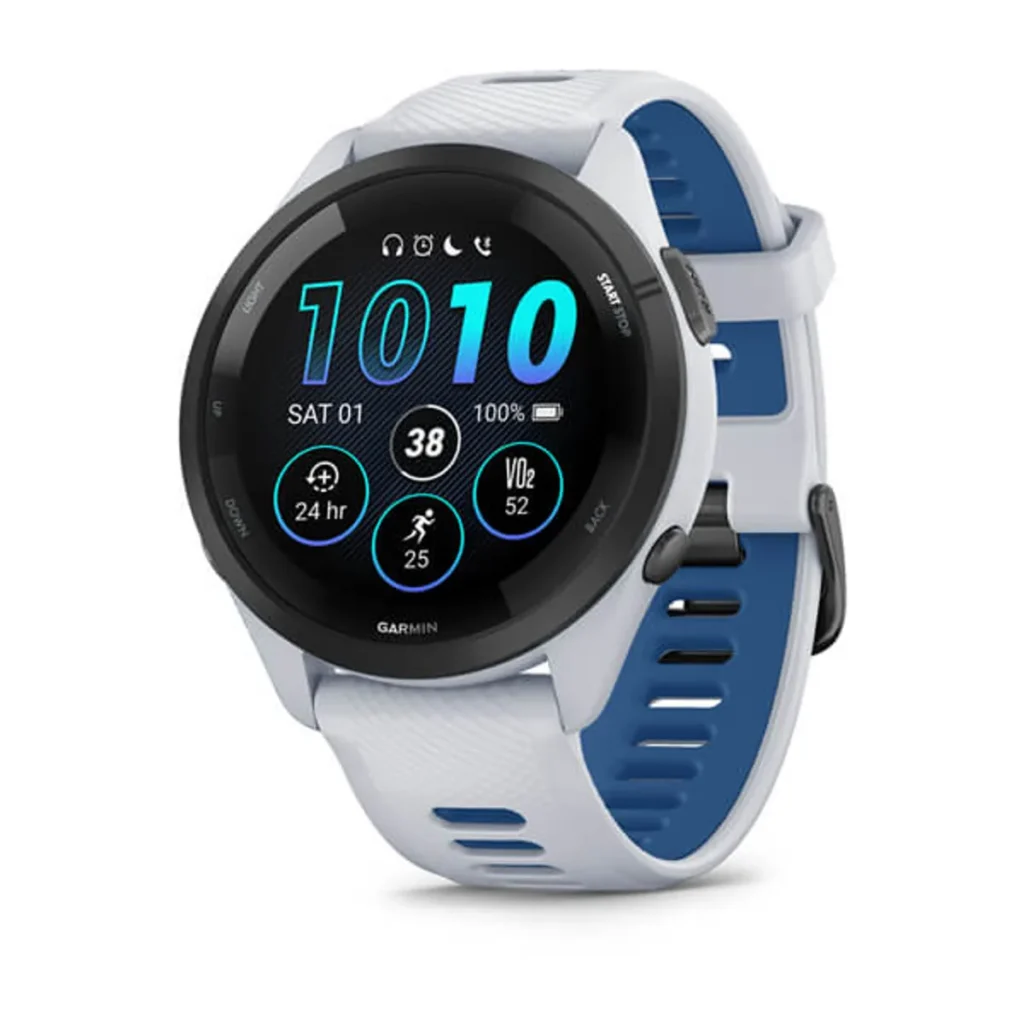
For a typical runner logging 30 to 50 miles a week, the 265 still means charging roughly once a week, which most people find fine. The 965’s advantage matters most on race day if you are out for longer than a road marathon. A 100K trail race or a long Ironman day can push past the 265’s comfortable range with accurate GPS switched on, while the 965 has margin to spare.
Music cuts both watches hard. Garmin rates the 265 at up to 6 hours in multi-band mode with music playing, and the 965 at up to 8.5 hours, so ultra runners who want playlists should lean toward the bigger watch. In DC Rainmaker’s in-depth 965 review, real-world drain landed close to Garmin’s claims with the always-on display enabled.
Maps and navigation
This is the feature that should decide most purchases. The Forerunner 965 carries full-color preloaded road and trail maps, ski resort maps and support for downloadable cartography. That unlocks map-based routing, round-trip course creation on the wrist and features such as ClimbPro, which breaks upcoming climbs into segments with grade and distance remaining.
The Forerunner 265 has no maps. It can follow a course you build in Garmin Connect or a third-party app, showing a breadcrumb line and turn alerts, and it can guide you back to your start. For marked race courses and familiar loops, that is usually all you need. For a new trail system or a city you are visiting, a real map is a big step up in confidence.
If you already own a phone mount or never run anywhere unfamiliar, skip the map premium. If you have ever been lost on a trail, this alone justifies the 965. Our guide to the best Garmin for running covers where maps start to matter across the wider lineup.
Training features and accuracy
Garmin gave both watches the same headline training tools: Training Readiness, HRV Status, morning reports, race-time predictions, daily suggested workouts and wrist-based running dynamics. Both use multi-band GPS, which is the main driver of track accuracy in tall-building downtowns and under heavy tree cover. Because they launched together on the same platform, reviewers who ran both side by side, including DC Rainmaker, treated GPS accuracy as a shared strength rather than a reason to pick one over the other.
At launch, DC Rainmaker documented a list of 965-only extras. The most useful for serious athletes are:
- The Stamina data field, which estimates how much time or distance you have left at your current effort.
- Training Load Ratio and Chronic Load, which flag when you are ramping mileage too quickly.
- ClimbPro and map-dependent navigation such as Next Fork.
- Recording of Garmin Cycling Dynamics from compatible power meters.
Garmin has shuffled features through firmware updates since 2023, so check the current spec pages if a specific metric is a deal-breaker. The general pattern holds, though: the 265 covers what a marathoner needs, and the 965 adds the long-day and multisport extras.
Both watches support triathlon and open-water swim profiles with 5 ATM water resistance, so either one works for a first triathlon. Riders with power meters get more out of the 965.
Build, size and comfort
The 965 feels a little more premium thanks to its titanium bezel and slightly tougher Gorilla Glass 3 DX lens, and its 1.4-inch display is noticeably roomier for maps. It is still light for its size at 53 g.
The 265 is lighter at 47 g, with a fiber-reinforced polymer bezel. Its real advantage is the 265S option, a smaller 42 mm version that suits slimmer wrists and, per Garmin, rates slightly longer battery life than the standard 265. There is no small 965, so runners with wrists under about 6 inches should think hard before buying the bigger watch.
Neither has a built-in LED flashlight; that arrived on the newer Forerunner 970.
Price and value in late 2026
Garmin’s US store still lists the Forerunner 265 at $449.99 and the 965 at $599.99 as of November 2026. Street prices are often lower: Tom’s Guide tracked the 265 at about $375 and the 965 at about $568 at Amazon in early 2026, and holiday sales routinely go deeper.
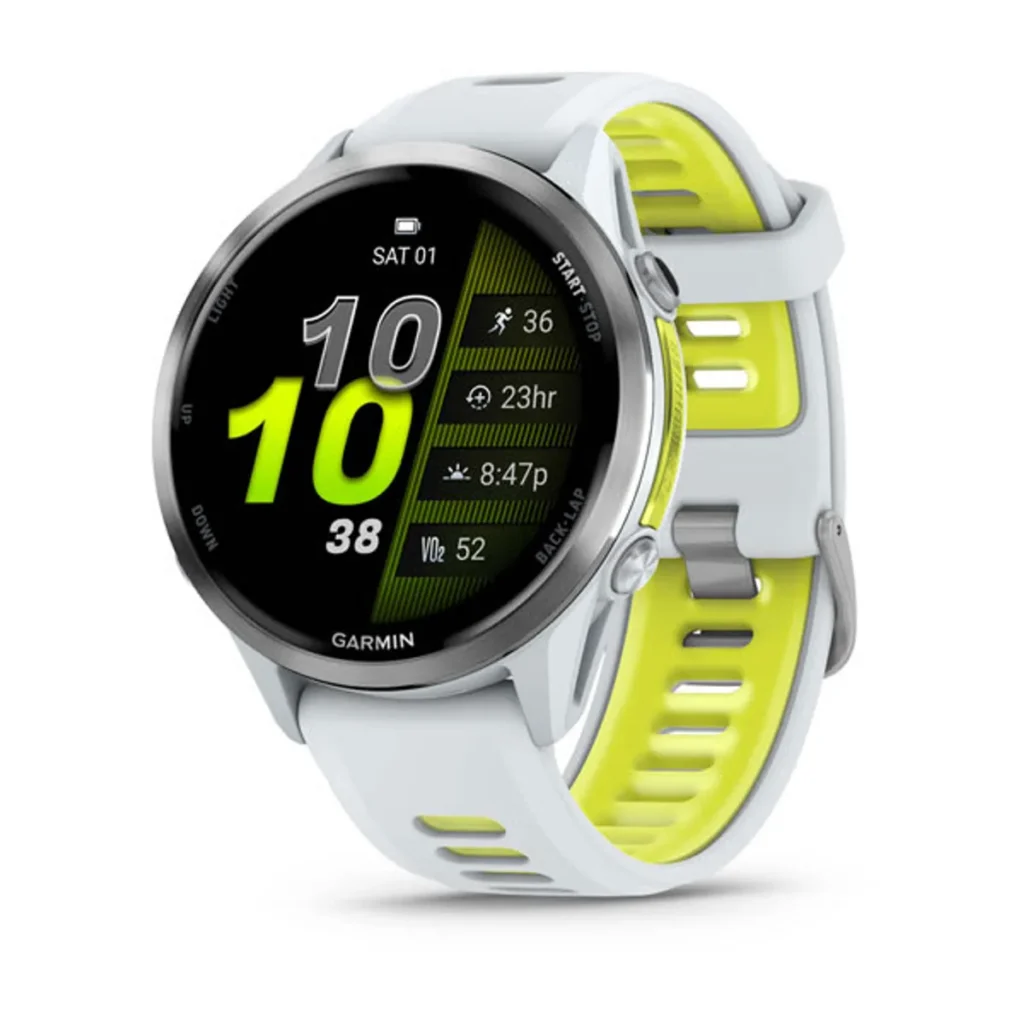
Against the newer generation, the math is simple. The Forerunner 570 launched at $549.99 and the Forerunner 970 at $749.99, so the older pair undercuts each successor by roughly $100 to $150 before any discount. Unless you specifically want the 970’s flashlight and newer navigation features, a discounted 965 delivers most of the same running experience.
If you are comparing across brands, our Coros vs Garmin breakdown and Garmin vs Apple Watch comparison explain how much of the ecosystem you give up by switching.
Who should buy which
Buy the Forerunner 265 if
You mostly run roads or known routes, train for distances up to the marathon, want a smaller 265S option, or would rather spend the $150 difference on shoes and race fees. It is one of the best value running watches Garmin has made.
Buy the Forerunner 965 if
You run trails or ultras, travel and run in unfamiliar places, ride with a power meter, or want to charge as rarely as possible. The maps, Stamina field and battery headroom are the reasons to pay more.
Consider something else if
You want the newest hardware, look at the Forerunner 570 or 970. If you need maps and serious toughness for hiking and the outdoors, the fenix and Instinct lines make more sense; see our best Garmin watch guide. On a tighter budget, the Coros Pace 3 offers excellent battery life for far less money, and our best running watch roundup covers more options.
FAQ
Is the Garmin Forerunner 965 worth it over the 265?
Only if you will use its maps, longer battery or endurance metrics such as Stamina and ClimbPro; for road running and marathon training, the 265 offers nearly the same experience for $150 less at list price.
What is the difference between the Forerunner 265 and 965?
The 965 adds full-color maps, 32 GB of storage (vs. 8 GB), a titanium bezel, a larger 1.4-inch display and longer battery life (31 vs. 20 hours of GPS), while both share AMOLED screens, multi-band GPS and Garmin’s core training metrics.
Does the Garmin Forerunner 265 have maps?
No, the Forerunner 265 can follow courses with a breadcrumb line and turn alerts, but it has no on-watch maps; you need the 965 or a newer model such as the 970 for full mapping.
Are the Forerunner 265 and 965 discontinued?
Both have been succeeded by the Forerunner 570 and 970, launched in 2025, but as of November 2026 Garmin still sells the 265 and 965 on its US website at $449.99 and $599.99.
Which is better for a marathon, the Forerunner 265 or 965?
Either one handles a marathon easily; the 265’s 14 to 20 hours of GPS covers any road marathon, so the 965 only becomes the better choice for ultras or very long triathlons.
Is the Forerunner 965 too big for small wrists?
At 47 mm and 53 g it can feel large on wrists under about 6 inches, and there is no smaller version, whereas the 265 comes in a 42 mm 265S size.
Sources
- Garmin: Forerunner 265 specs
- Garmin: Forerunner 965 specs
- Garmin: Running watches lineup
- DC Rainmaker: Garmin Forerunner 965 In-Depth Review
- TechRadar: Garmin Forerunner 965 vs Garmin Forerunner 265
- Tom’s Guide: Best Garmin deals