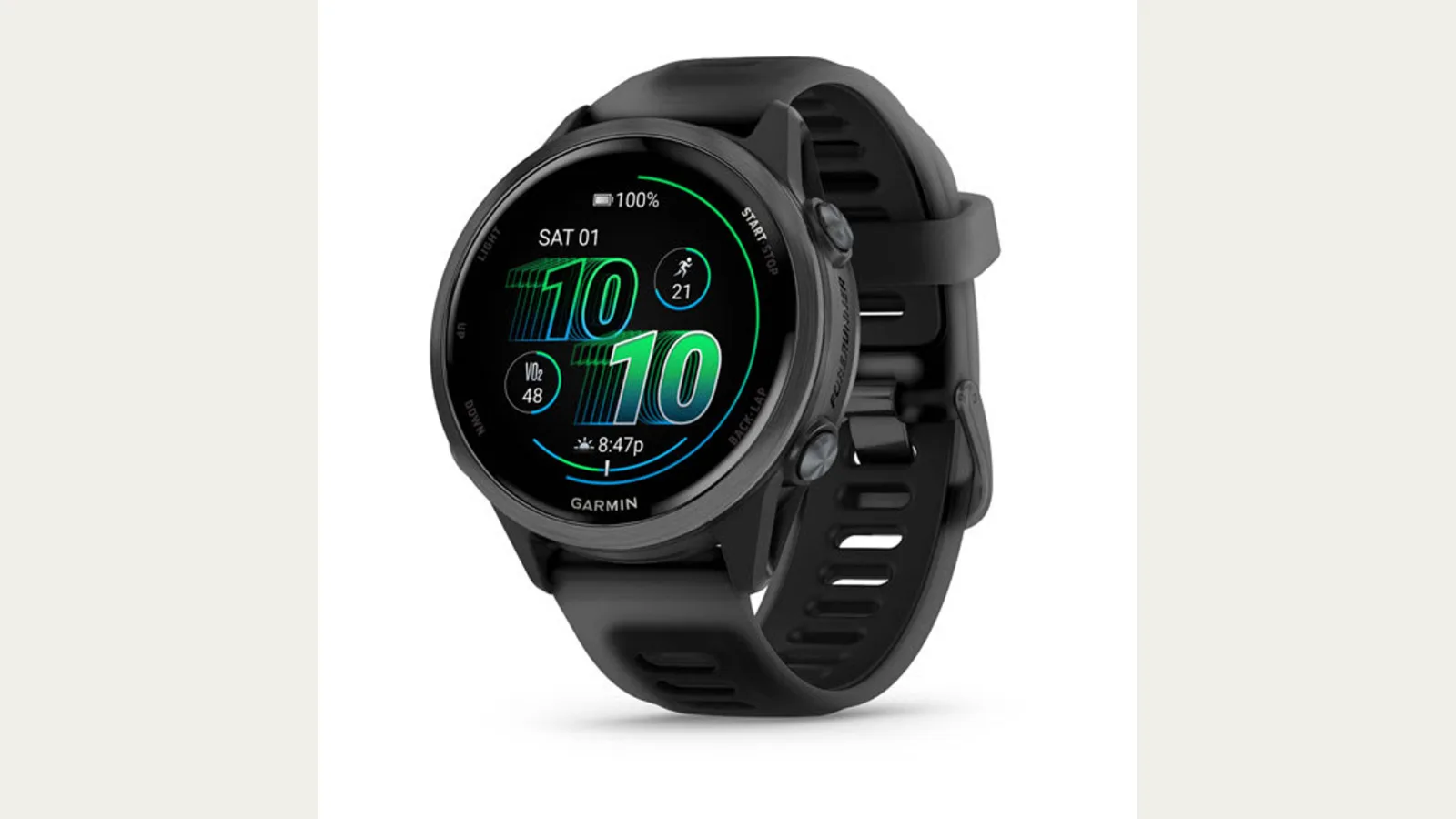
Featured image: Garmin
The best Garmin for running is the Forerunner 570 for most people, the Forerunner 970 if you want maps, titanium and the longest battery, and the Forerunner 170 or 70 if you want Garmin’s coaching on a budget.
Quick answer Buy the Garmin Forerunner 570 (about $550) if you run seriously and want dual-band GPS and an AMOLED screen without paying flagship money. Step up to the Forerunner 970 (about $750) for offline maps, ECG and 26 hours of GPS battery. If you are newer to running, the Forerunner 170 (about $300) and Forerunner 70 (about $250), both launched in May 2026, cover the basics well. This guide only covers current Forerunners; for the full Garmin range, see our best Garmin watch guide.
The short list
Garmin’s current Forerunner line has four models, and they are easy to tell apart once you know what each one drops. Prices below are Garmin’s US list prices, and retailers often discount them.
- Best overall: Garmin Forerunner 570, about $550. Dual-band GPS, Elevate Gen 5 heart rate sensor, 42mm or 47mm.
- Best premium: Garmin Forerunner 970, about $750. Titanium bezel, sapphire lens, offline maps, ECG, flashlight.
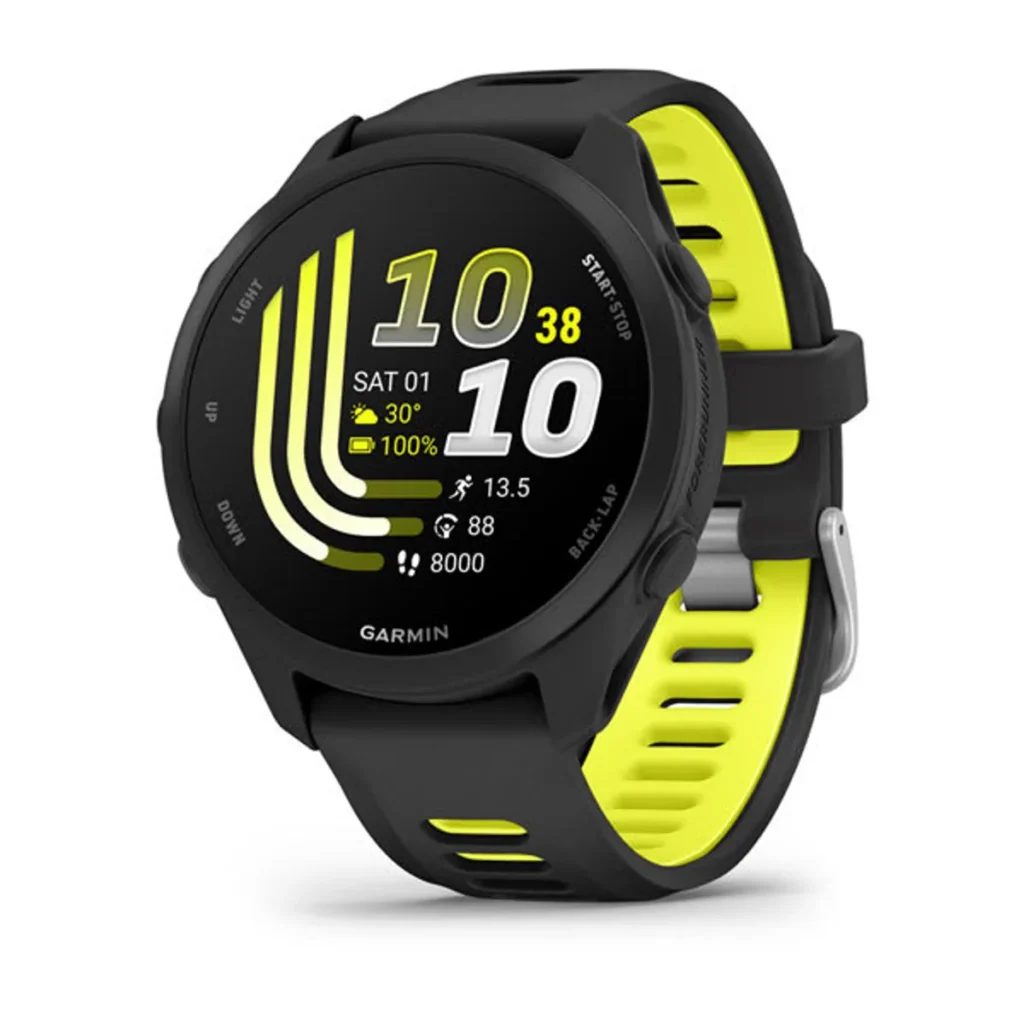
- Best value: Garmin Forerunner 170, about $300 ($350 for the Music version). The sweet spot for most newer and mid-level runners.
- Best budget: Garmin Forerunner 70, about $250. The cheapest way into Garmin’s training tools.
We have not tested these watches ourselves. Everything here is drawn from Garmin’s specifications and reviews by DC Rainmaker, Tom’s Guide, Wareable and the5krunner, which are listed at the end.
The best Garmin running watches, pick by pick
Garmin Forerunner 570: best for most runners
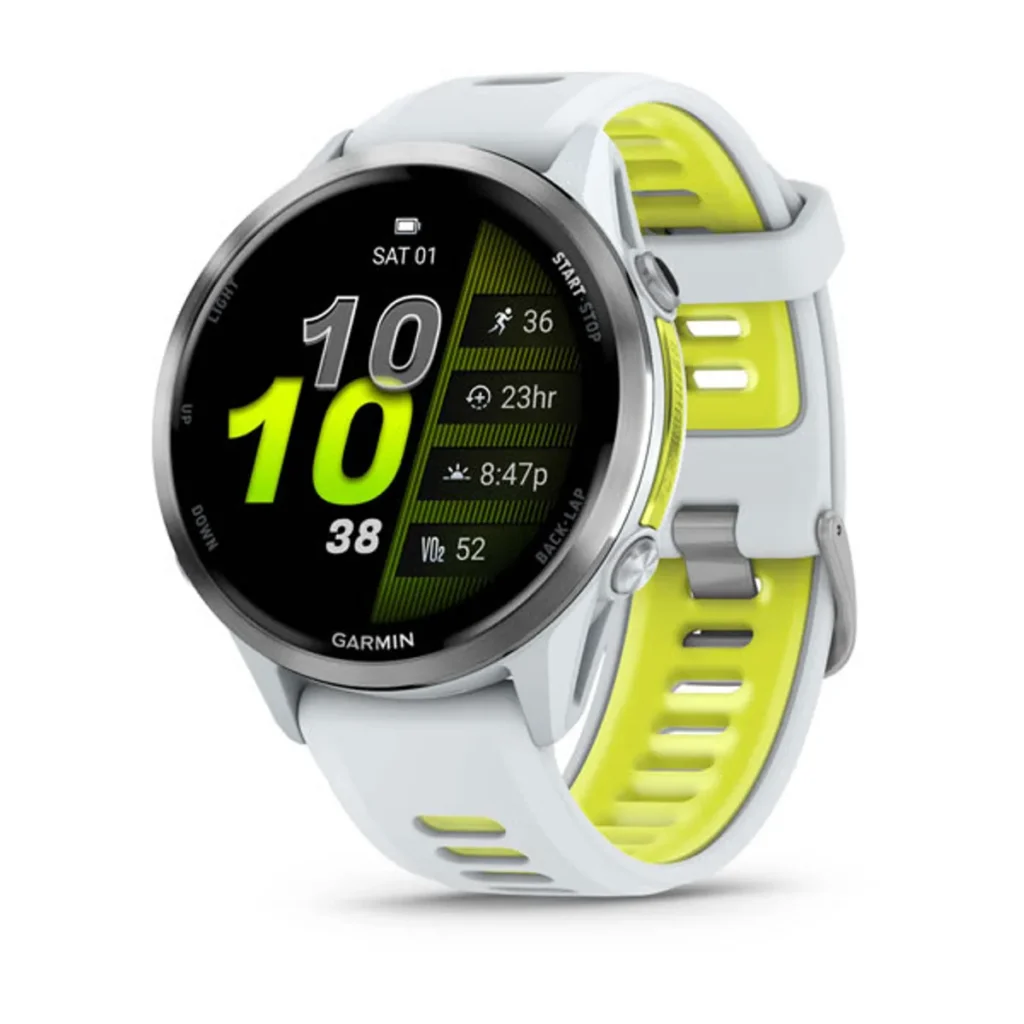
The Forerunner 570 launched in May 2025 and is the watch most runners should start with. It comes in 42mm and 47mm cases, has a bright AMOLED screen, and adds multi-band (dual-frequency) GPS that holds up better among tall buildings and under tree cover than the single-frequency chips on cheaper models.
It also carries Garmin’s Elevate Gen 5 heart rate sensor, a built-in speaker and microphone for taking calls from the wrist, and 8GB of storage for offline Spotify, Amazon Music, Deezer and YouTube Music playlists. Tom’s Guide found the GPS accurate against the older Forerunner 265 on a twisting city half marathon.
The trade-offs are price and battery. Tom’s Guide called it a great sports watch but not a great-value one, and pointed out that the Forerunner 265 often costs far less. There are also no onboard maps (breadcrumb navigation only) and no ECG. If neither matters to you, the 570 is the sensible choice.
| Spec | Garmin Forerunner 570 |
|---|---|
| Case size | 42mm (42g) or 47mm (50g) |
| Bezel and lens | Aluminum bezel, chemically strengthened glass |
| Display | AMOLED, 1.2 in (42mm) or 1.4 in (47mm) |
| GPS | Multi-band GNSS with SatIQ |
| Battery (47mm) | Up to 11 days smartwatch, 18 hours GPS-only, 14 hours multi-band GPS |
| Water resistance | 5 ATM (50m) |
| Music | 8GB offline storage |
| Approx. price | About $550 (Garmin list price) |
Where to buy
Compare the same watch on both sites: eBay for pre-owned and vintage pieces, Amazon for new stock.
Garmin Forerunner 570
Garmin Forerunner 970
Garmin Forerunner 170 Alternative
Garmin Forerunner 70 Alternative
Prices and availability change; check the listing before you buy.
Garmin Forerunner 970: best premium running watch
The Forerunner 970 is Garmin’s top running and triathlon watch. It has a 47mm titanium bezel, a sapphire lens, a 1.4-inch AMOLED screen and 32GB of music storage. Unlike the 570 it has preloaded, routable topographic maps, which makes it far better for trail runs and unfamiliar routes.
It also has ECG, a built-in LED flashlight, and the longest battery in the range: Garmin rates it for up to 15 days as a smartwatch, 26 hours in GPS-only mode and 21 hours in multi-band GPS. DC Rainmaker reported near-perfect GPS tracks and good optical heart rate accuracy on land, and liked the new Impact Load metric.
The downsides are the roughly $750 price, a weight of about 56g, and some features that need extras. Running Economy and Step Speed Loss need Garmin’s separate HRM 600 chest strap, which is about $170 more. DC Rainmaker also noted slow map drawing and weaker open-water swim tracking than usual. If you do not need maps or ECG, the 570 gives you most of the running experience for roughly $200 less.
Garmin Forerunner 170: best value
The Forerunner 170 arrived in May 2026 as the replacement for the Forerunner 165. It is a 43mm watch weighing 41g with a 1.2-inch AMOLED screen, and it costs about $300, or about $350 for the Music version with 4GB of offline audio.
It keeps Garmin’s training status, training readiness and training load tools, plus Garmin Pay, a barometric altimeter and 5 ATM water resistance. Tom’s Guide found GPS and heart rate accuracy good overall and called it a clear step up from the 165.
What you give up compared with the 570 is multi-band GPS (the 170 is single-frequency), the Gen 5 heart rate sensor, and a few of the newer running metrics. Battery is also shorter: about 10 days as a smartwatch and 20 hours of GPS, but roughly four days with the always-on display. There is no triathlon mode either. For a runner who mostly trains on roads and paths, those are reasonable compromises.
Garmin Forerunner 70: best budget Garmin for running
The Forerunner 70 launched alongside the 170 at about $250. It shares the 43mm AMOLED design and 40g weight, and Garmin’s coaching and recovery features carry over. It actually beats the 170 on endurance, with up to 13 days as a smartwatch and 23 hours of GPS-only battery.
The savings come from sensors and extras. It has no barometric altimeter, so elevation tracking is less precise, and it lacks the music and payment features, as well as the ability to pair cycling sensors. Tom’s Guide and the5krunner both suggest that if you do not want the smart features, the 70 is the better buy than the 170.
How the four compare side by side
Here is the whole line in one table. All four use AMOLED touchscreens and Garmin’s current software, and all are rated to 5 ATM.
| Spec | Forerunner 70 | Forerunner 170 | Forerunner 570 | Forerunner 970 |
|---|---|---|---|---|
| Approx. price | About $250 | About $300 ($350 Music) | About $550 | About $750 |
| Case size and weight | 43mm, 40g | 43mm, 41g | 42mm (42g) or 47mm (50g) | 47mm, 56g |
| Bezel and lens | Fibre-reinforced polymer case, chemically strengthened glass | Fibre-reinforced polymer case, chemically strengthened glass | Aluminum, strengthened glass | Titanium, sapphire |
| GPS type | Single-frequency | Single-frequency | Multi-band | Multi-band |
| Smartwatch battery | Up to 13 days | Up to 10 days | 10 to 11 days | Up to 15 days |
| GPS-only battery | Up to 23 hours | Up to 20 hours | Up to 18 hours | Up to 26 hours |
| Heart rate sensor | Elevate Gen 4 | Elevate Gen 4 | Elevate Gen 5 | Elevate Gen 5 plus ECG |
| Music storage | None | 4GB (Music model) | 8GB | 32GB |
| Offline maps | No | No | No | Yes |
How to choose a Garmin running watch
GPS accuracy
Single-frequency GPS is fine for open roads and parks. If you run in a dense city or heavily wooded trails, multi-band GPS on the 570 and 970 reduces drift, which is the main reason to spend more.
Battery life
Marathon runners are well covered by any of the four, since even the 570’s 18 hours of GPS is plenty. Ultra and long trail runners should look at the 970’s 26 hours, or at a different Garmin line altogether. For that, see our best Garmin watch roundup and our guide to the Garmin Instinct 3, which trades running metrics for much longer battery.
Maps and navigation
Only the 970 has full topographic maps. The others give you breadcrumb trails and basic turn-by-turn prompts, which is enough for following a loaded route but not for exploring.
Heart rate, ECG and recovery
The Gen 5 sensor on the 570 and 970 is the newer design, and only the 970 adds ECG. All four give you training load and recovery guidance, so the coaching experience is similar across the range.
Size and comfort
The 70, 170 and 42mm 570 are small and light, which suits slimmer wrists and sleep tracking. The 47mm 570 and the 970 are fuller-sized watches that read better at a glance.
Garmin or something else?
If you are weighing Garmin against an Apple Watch for running, we compared them for athletes in Garmin vs Apple Watch. In short, Garmin wins on battery and training depth, and Apple wins on everyday smart features.
What about the older Forerunner 265 and 965?
The Forerunner 265 and 965 are the previous generation and are still sold at many retailers, often at a discount. Reviewers note that they run Garmin’s older interface and are not expected to get the new software features that the 170, 570 and 970 share. Tom’s Guide suggests the 265 is the better buy than the 570 on price alone.
A discounted 265 can make sense if the price gap is large, but we have not covered it as a pick here because it is no longer the current model. Check the listing carefully, since stock and prices change. If you are choosing between the two older models, our Forerunner 265 vs 965 comparison breaks down the maps, battery and price differences.
Which one should you buy?
Choose the Forerunner 570 if you run regularly, want accurate tracking in tricky conditions and are happy with breadcrumb navigation. Choose the Forerunner 970 if you run trails, want offline maps or ECG, or need the longest battery. Choose the Forerunner 170 if you are a newer or road-focused runner who still wants music, payments and a barometer. Choose the Forerunner 70 if you want Garmin’s training tools and the longest battery per dollar.
Whichever you pick, you are getting Garmin’s current training software, so you can always move up later without relearning the interface.
FAQ
What is the best Garmin for running?
For most runners it is the Garmin Forerunner 570, which combines multi-band GPS, an AMOLED display and the latest heart rate sensor for about $550. The Forerunner 970 is the better choice if you want offline maps, ECG and longer battery, at about $750.
Which Garmin Forerunner should I buy in 2026?
Buy the Forerunner 570 for the best balance, the 970 for a premium trail and triathlon watch, the 170 for good value at about $300, or the 70 for the lowest price at about $250. The 170 and 70 only launched in May 2026.
Is the Garmin Forerunner 970 worth the extra money over the 570?
It is worth it if you want offline topographic maps, ECG, a titanium bezel and sapphire lens, or up to 26 hours of GPS battery. If you mostly run familiar roads, reviewers generally find the 570 delivers most of the running experience for about $200 less.
What is the best cheap Garmin for running?
The Forerunner 70 at about $250 is Garmin’s cheapest current running watch, with AMOLED display, training tools and up to 23 hours of GPS battery. The Forerunner 170 at about $300 adds a barometric altimeter, Garmin Pay and a Music version.
Do I need dual-band GPS for running?
No, it is not essential. Single-frequency GPS works well on open roads and trails, but multi-band GPS on the 570 and 970 gives steadier tracks in city canyons and under dense tree cover.
Is the Garmin Forerunner 265 still worth buying?
It can be if you find it for much less than a 170 or 570, since it has multi-band GPS and triathlon features. It is an older generation, though, so it will not share the newest software features.
Sources
- Garmin: Forerunner 570 product page
- DC Rainmaker: Garmin Forerunner 970 in-depth review
- Tom’s Guide: Garmin Forerunner 570 review
- Tom’s Guide: Garmin Forerunner 170 review
- Wareable: Garmin Forerunner 970 vs 570 comparison
- the5krunner: Garmin Forerunner 70 specifications