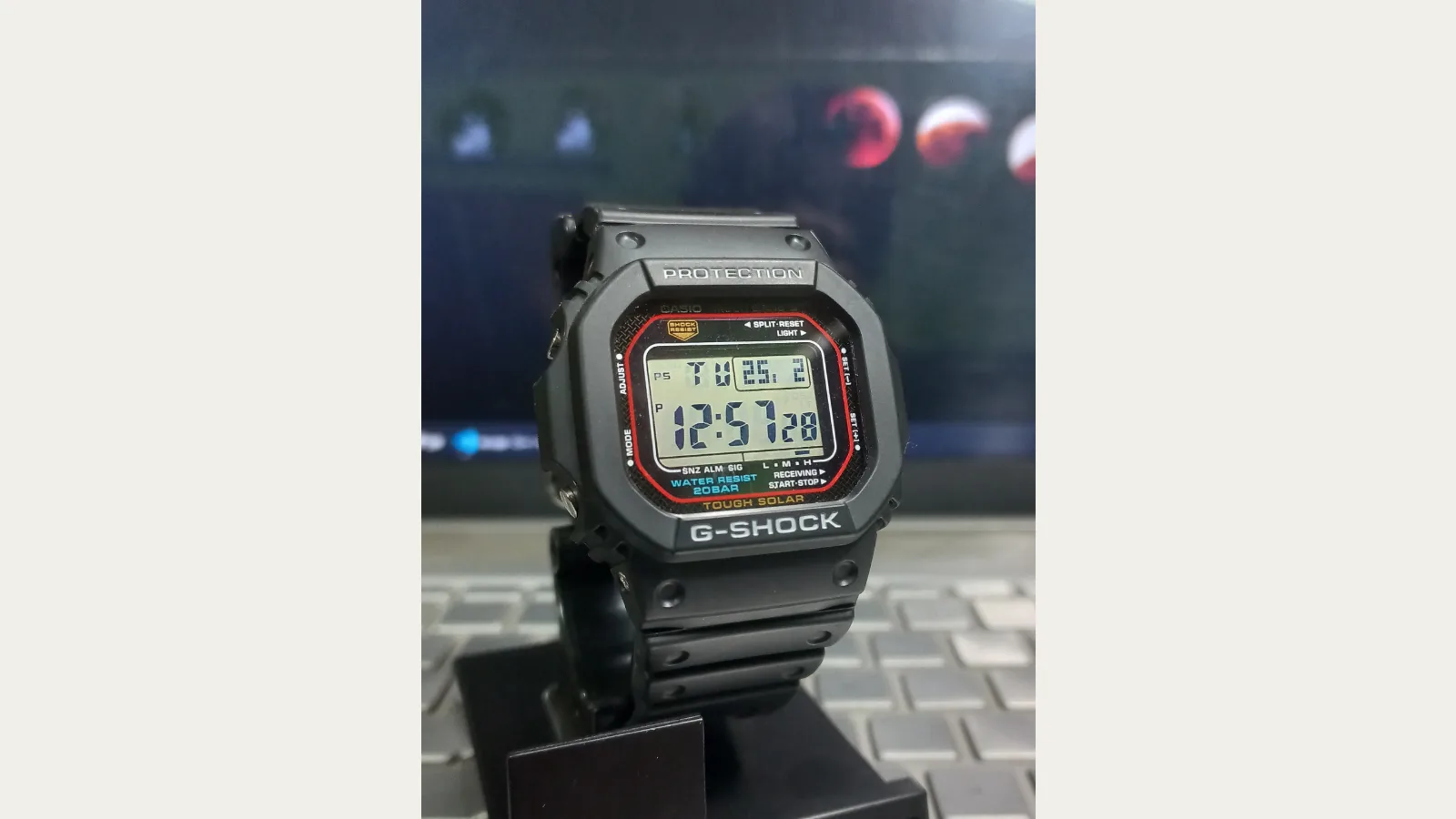
Featured image: Md. Rifat Hasan Jihan, CC BY-SA 4.0, via Wikimedia Commons
Yes, soldiers wear G-Shocks — four Casio models have held official US military NATO Stock Numbers, Navy SEALs carried the DW-6600 into some of the most documented special operations missions of the 2000s, and USSOCOM placed a purchase order for roughly 1,000 Mudman G-9000s as recently as 2014.
Quick answer — Soldiers do wear G-Shocks, and four models (the DW-5600, DW-6600, DW-6900, and DW-9052) have held official US military NATO Stock Numbers, allowing units to order them through the official supply chain. Casio currently has no active military sponsorship, and by 2024 Garmin dominates for navigation-heavy missions — but G-Shocks remain common where covertness, simplicity, budget, or extreme water exposure is the priority.
The Answer: Yes, Soldiers Wear G-Shocks
The relationship between G-Shock and the military was never top-down. Casio did not design the watch for soldiers, and the US armed forces never issued a sole-source contract. What happened instead is that soldiers — particularly Navy SEALs and other special operations personnel — started buying G-Shocks on their own because the watch survived conditions that destroyed everything else. That grassroots adoption eventually produced four formal NATO Stock Numbers and a string of documented bulk purchases that make the military-G-Shock connection as well-documented as any in tactical watch history.
Casio’s own military page states the position plainly: historically four G-Shock models were approved by the US armed forces and issued a NATO Stock Number (NSN), which allows military units to order them through the official supply chain. There is currently no active military sponsorship or endorsement from any branch. The adoption, in short, came from the ranks up.
The Four G-Shocks That Held Official US Military NSNs
Four models received NATO Stock Numbers, making them orderable through official US military procurement channels. All four share G-Shock’s standard 200m water resistance and quartz digital movement.
| Spec | DW-5600 / UE-1 | DW-6900-1V | DW-9052-1V |
|---|---|---|---|
| Case material | Resin | Resin | Resin |
| Case size | 48.9 × 42.8 × 13.4 mm | 53.7 × 50.1 × 16.9 mm | 50.4 × 46.9 × 16.4 mm |
| Movement | Quartz digital | Quartz digital | Quartz digital |
| Water resistance | 200m | 200m | 200m |
| Battery life | Approx. 2 years | Approx. 2 years | Approx. 2 years |
| Approx. price | About $75 | About $75 | About $65 |
The DW-6600-1V, which no longer appears in Casio’s regular lineup, is the most historically significant of the four. Naval Special Warfare Command placed its final official order for the DW-6600-1V in 2009. The model was documented as effectively replacing the Rolex Submariner as the standard watch for Navy SEAL qualification training, according to research by the military watch publication Watches of Espionage. Navy SEAL Chris Kyle described wearing a DW-6600-1V during his deployments in his memoir, and the model appeared in the 2014 film American Sniper.
The DW-6900-1V is the current production successor. It carries an NSN and shows up most frequently in military photographs taken after 2018, including US-Nepal joint special operations training and special operations dive events as recently as 2024. The DW-9052-1V was issued to students at the Naval Diving and Salvage Training Center and to new BUD/S SEAL candidates through approximately 2018, partly because its larger buttons are easier to operate with gloves.
Beyond the NSN models, USSOCOM placed documented purchase orders totaling approximately 1,000 G-9000-1V Mudman watches in 2014 — two separate orders of roughly 400 and 600 units — despite the Mudman having no NSN. Photographs confirm SEAL operators wearing the G-9000 during vessel boarding and seizure training drills.
Where to buy
Compare the same watch on both sites: eBay for pre-owned and vintage pieces, Amazon for new stock.
undefined
undefined
undefined
undefined
Prices and availability change; check the listing before you buy.
Why Soldiers Choose G-Shock Over Other Watches
The core technology behind every G-Shock is the floating module: the timekeeping movement rests at only a few fixed contact points inside a hollow case, so impacts are absorbed by the structure rather than transmitted directly to the electronics. Kikuo Ibe developed the design in 1983 after more than 200 prototypes, reportedly inspired by watching children play with a rubber ball. The result is a watch that can survive a three-meter fall — one of the 18-shock sequences in MIL-STD-810 testing — and keep running.
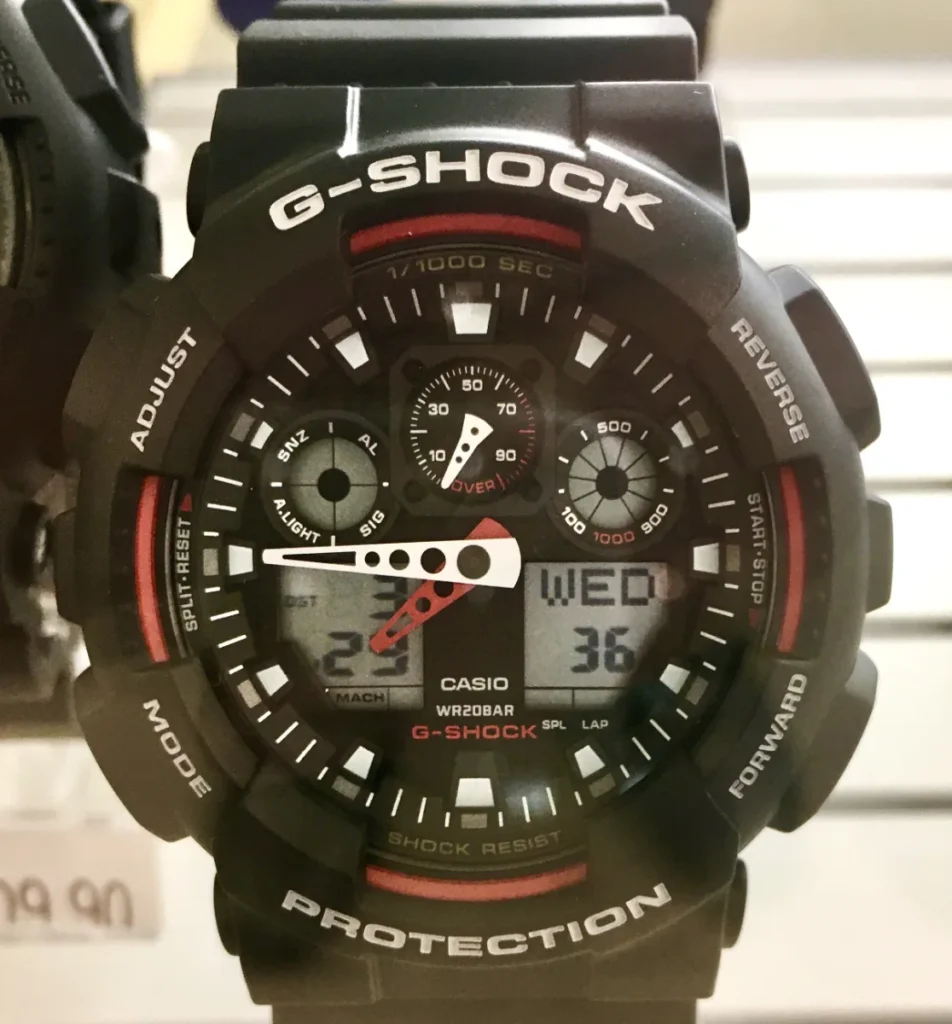
Five G-Shock models have been independently tested to MIL-STD-810 by Element, an accredited third-party laboratory in Boxborough, Massachusetts. The 12 test methods include salt fog, freeze-thaw cycling (20 cycles between 0°C and 10°C), 65°C high temperature, -20°C low temperature, immersion to one meter for 30 minutes, random vibration from 20 to 2,000 Hz, and sand-and-dust exposure. The five tested models are the GG-B100XM-1A Mudmaster, GW-9400-1 Rangeman, DW-5600UBB-1, GA-2100-1A1, and GBD-200-1.
Beyond the structural toughness, several properties matter specifically in military environments:
| Property | Specification | Military Relevance |
|---|---|---|
| Magnetic resistance | 4,800 A/m (ISO 764) | Near vehicle engines, helicopter avionics, and weapon systems |
| Water resistance | 200m (20 bar) | Amphibious operations, vessel boarding, full immersion diving |
| Battery life | 2–3 years standard; indefinite with Tough Solar | No charging infrastructure needed in the field |
| Backlight | Auto EL/LED with afterglow | Night operations without a flashlight |
| Button size | Large on DW-9052 and Rangeman | Operation with cold-weather gloves or NBC gear |
| Case finish | Matte resin, non-reflective | No glint signatures in daylight |
| Price | About $65–$350 | Effectively disposable in the field |
The magnetic resistance point is underappreciated. Conventional mechanical watches can be disrupted by magnetic fields found near military vehicles, helicopter avionics, and even some weapons systems. G-Shock’s digital quartz movement has no coils or springs sensitive to magnetism, making it inherently reliable in those environments.
One additional factor documented by real operators: in classified spaces, soldiers sometimes prefer a watch that cannot be tracked. NSW Group 8 operators were photographed at a 2024 special operations dive event wearing personal DW-6900 G-Shocks rather than their issued Garmin units, specifically because removing a GPS-enabled smartwatch is required in some classified environments.
G-Shock vs. Garmin in the Field Today
The honest picture from 2024 is that Garmin has largely displaced G-Shock for navigation-intensive missions at the top-tier special operations level. Research by Watches of Espionage at a 2024 invite-only special operations dive event found Garmin units (Tactix and Fenix families) worn by the majority of US and allied SOF participants, with G-Shock appearing only once — the personal DW-6900 noted above. French Commando Hubert wore the Garmin Descent Mk2; Danish Frogman Corps wore Garmin; the German Kampfschwimmer wore the Sinn UX S, their official issue.
The divergence makes practical sense. For land navigation, patrol planning, and fitness tracking, a Garmin Instinct 3 or Fenix offers multi-GNSS GPS, barometric altimeter, and a navigation interface that G-Shock models below the Rangeman tier simply cannot match. If you want a detailed side-by-side of those two Garmin lines, the Garmin Instinct vs. Fenix guide covers each decision factor.
G-Shock holds its own where Garmin falls short: covert operations where GPS/Bluetooth creates an electronic signature, underwater diving beyond Garmin’s 100m rating, and very long deployments without charging infrastructure. A DW-6900’s two-year battery requires no cables; a Garmin Fenix needs charging every two weeks. For firefighters and other emergency responders operating in similar environments, the same logic applies — the firefighter watch guide explores how those professionals make the same G-Shock versus smartwatch trade-off.
Which G-Shock Should You Buy for Military or Tactical Use
The right G-Shock depends on how you will use it. The models below represent the clearest options across the price range, based on documented military use and independently verified specifications.
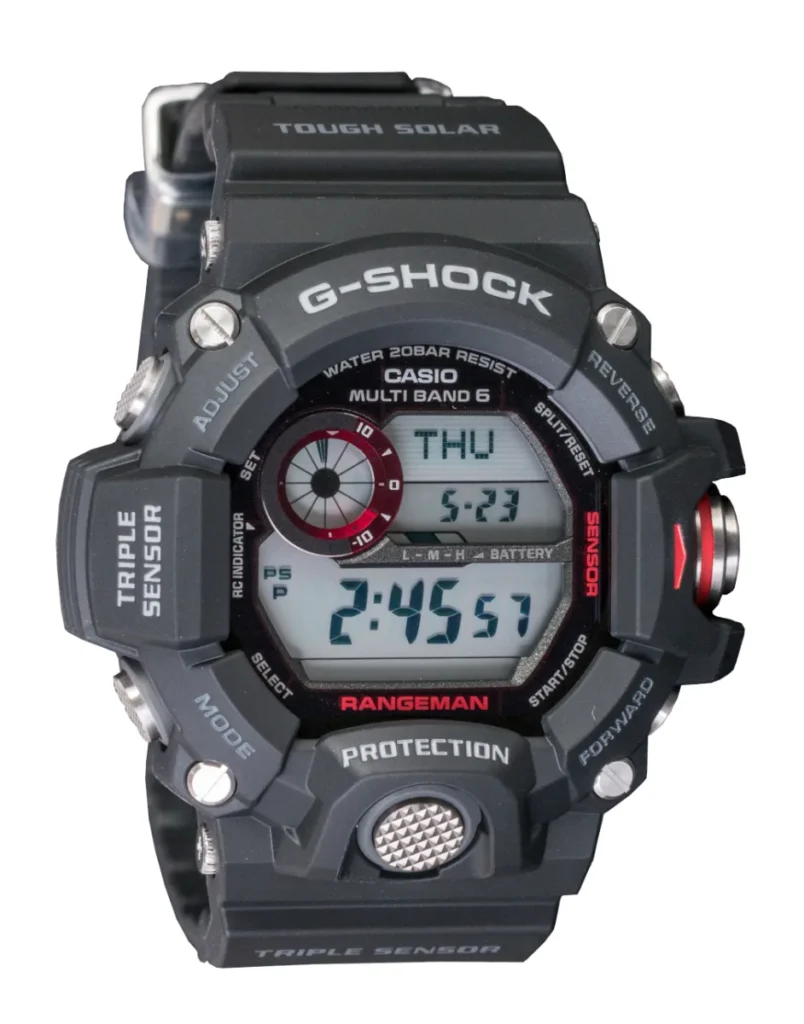
DW-6900-1V — Best Entry-Level Military G-Shock
The DW-6900-1V is the current production successor to the DW-6600 worn by Navy SEALs through the 2000s. It carries an NSN and appears in military photographs as recently as 2024. The triple-eye case gives it a distinctive look, the full-auto EL backlight is useful at night, and the price — roughly $75 — makes it genuinely replaceable in the field. This is the starting point for anyone who wants a G-Shock with documented military provenance.
DW-5600BB-1 — Best Blacked-Out Option
The DW-5600 platform covers the original G-Shock form factor: a small, square, all-digital case. The DW-5600BB-1 runs the same design in an all-black finish — no silver accents, no reflective surfaces — at around $79. Its sibling the DW-5600UBB-1 (about $89) adds the updated display and is one of the five MIL-STD-810-tested models. Both carry on the same form factor that CIA personnel carried into Afghanistan shortly after September 11, 2001, and both are roughly the smallest and lightest option in the military G-Shock lineup.
GW-9400-1 Rangeman — Best Full-Featured Tactical G-Shock
The Rangeman is the most capable G-Shock designed around military and outdoor use. It packs a triple sensor (compass, barometer/altimeter, thermometer) with 40-record sensor memory, Tough Solar charging, Multi-Band 6 atomic timekeeping, and a case tested to MIL-STD-810. Large, clearly marked buttons are designed to operate with gloves; the olive/military colorway (GW-9400-3) is specifically intended for field use. At roughly $200, it costs more than the basic NSN models but less than the Garmin Instinct tier, and it requires no charging. For a detailed look at the premium G-Shock mud-resistant range, the Casio G-Shock Mudmaster review covers the step up to the Mudmaster line.
GG-B100-1A Mudmaster — Best Premium Choice
The Mudmaster is Casio’s current flagship for extreme environments. Carbon Core Guard construction uses a glass-fiber-reinforced resin bezel; the mud-resistant ports are sealed against dirt and grit as well as water; and the quad sensor adds a step counter to the Rangeman’s triple-sensor suite. It is one of the five MIL-STD-810-tested models and connects via Bluetooth to a smartphone for time synchronization and sensor logging. The price of around $350 puts it at the top of the G-Shock range before the MR-G tier, and it is the closest G-Shock analogue to what a tactical equipment buyer would evaluate alongside a Garmin Tactix.
| Model | Ref | NSN? | MIL-STD-810? | Sensor | Battery | Approx. Price |
|---|---|---|---|---|---|---|
| DW-5600BB | DW-5600BB-1 | Related family | No (UBB version: yes) | None | ~2 yr | About $79 |
| DW-6900 | DW-6900-1V | Yes | No | None | ~2 yr | About $75 |
| Rangeman | GW-9400-1 | No | Yes | Triple (compass, baro/alt, temp) | Tough Solar | About $200 |
| Mudmaster | GG-B100-1A | No | Yes | Quad + Bluetooth | Tough Solar | About $350 |
FAQ
Do Navy SEALs actually wear G-Shock watches?
Yes. The DW-6600-1V was a documented standard watch during Navy SEAL qualification training, and Naval Special Warfare Command placed a final official supply-chain order for it in 2009. Chris Kyle described wearing a DW-6600-1V during service, and the DW-9052-1V was issued to BUD/S candidates and Navy diving students through approximately 2018. As of 2024, SEALs are more commonly photographed in Garmin units for navigation-heavy work, though personal G-Shocks still appear in classified or water-intensive settings.
Which G-Shock has an official military NSN?
Four models have held official US military NATO Stock Numbers: the DW-5600E-1V, DW-6600-1V, DW-6900-1V, and DW-9052-1V. The DW-6600-1V is discontinued; the other three are still available. Casio notes that there are currently no active US military-sponsored G-Shock watches.
Is the G-Shock MIL-SPEC certified?
Five G-Shock models have been independently tested to MIL-STD-810 by an accredited third-party laboratory: the GG-B100XM-1A Mudmaster, GW-9400-1 Rangeman, DW-5600UBB-1, GA-2100-1A1, and GBD-200-1. This means those specific models passed 12 MIL-STD-810 test methods including drop, vibration, temperature extremes, salt fog, and immersion. Casio does not claim an overall G-Shock line certification, only those five tested models.
What watch does the US Army issue to soldiers?
The US Army has no single universally issued wristwatch. Units and individuals select their own watches, though Garmin has become a common choice for SOF units due to GPS navigation capability. G-Shock has no current active-duty issue contract, but NSN listing allows units to order the DW-6900-1V and DW-9052-1V through official supply channels.
Why do special forces prefer G-Shock in some situations over Garmin?
Three documented reasons appear repeatedly in operator accounts: G-Shock has no GPS or Bluetooth signal that could reveal position in classified environments; its battery lasts two to three years without charging; and its 200m water resistance exceeds most Garmin models’ 100m rating for amphibious operations. Garmin dominates for land navigation and fitness tracking, but G-Shock is preferred when the mission requires a watch that is invisible electronically, indefinitely battery-independent, or rated for full diving depth.
How much did a military G-Shock cost?
The NSN-listed models were and remain inexpensive by military standards: the DW-5600, DW-6900, and DW-9052 all retail for roughly $65 to $89. The low cost is part of the appeal — a watch that sells for $75 can be replaced without paperwork, worn in conditions that would destroy an issued instrument, and left behind without career consequences. The Rangeman and Mudmaster represent the premium tier at roughly $200 and $350.
Sources
- Casio G-SHOCK: Military Watches (official)
- Casio G-SHOCK: MIL-STD-810 Mil-Spec Watches (official)
- Watches of Espionage: The History of Casio G-Shocks and the US Military
- Watches of Espionage: Digital Watches of the Global War on Terror
- G-Central: Navy SEALs and the DW-6600
- G-Central: DW-9052 and G-9000 Also Used by Navy SEALs