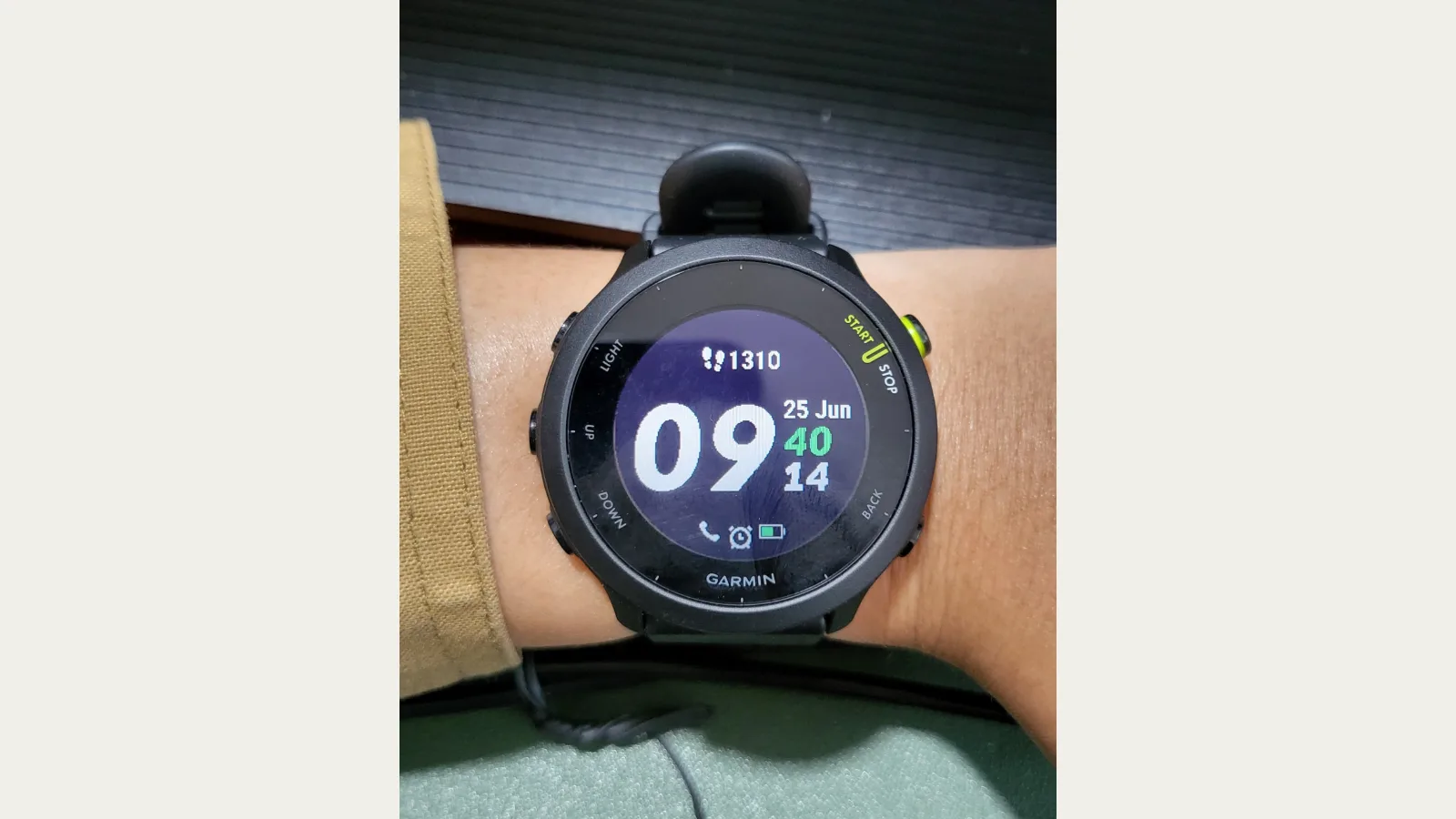
Featured image: Melyanac / CC0
Quick Facts: Garmin Forerunner 55
- Price: Around $149–$169
- Display: 1.04-inch MIP, 208×208px
- Battery life: 14 days (smartwatch), 20 hours (GPS mode)
- Water resistance: 5 ATM
- Weight: 37g
- GPS: Yes (GPS + GLONASS)
- Heart rate: Optical wrist-based
- Best for: New runners and casual athletes on a budget
The Garmin Forerunner 55 is Garmin’s entry point into proper GPS running watches. It costs around $149–$169, tracks your runs with GPS, monitors your heart rate on the wrist, and lasts up to 14 days on a charge. For anyone moving up from a fitness tracker or a phone app, it’s a compelling first step.
But is it the right watch for you? In this review, we’ll cover everything: how well it tracks, what the display is like, how it performs on longer runs, and who should — or shouldn’t — buy it.
Where to buy
Compare the same watch on both sites: eBay for pre-owned and vintage pieces, Amazon for new stock.
Prices and availability change; check the listing before you buy.
Garmin Forerunner 55: Specs and What’s in the Box
The Garmin Forerunner 55 ships with the watch and a USB-A charging cable. There’s no extra strap in the box, though Garmin’s standard 20mm quick-release bands are widely available and affordable.
| Specification | Garmin Forerunner 55 |
|---|---|
| Case size | 42 × 42 × 11.6mm |
| Weight | 37g (without band) |
| Display type | MIP (memory-in-pixel) LCD |
| Resolution | 208 ‘times; 208 px, 1.04 inches |
| Battery (smartwatch) | Up to 14 days |
| Battery (GPS mode) | Up to 20 hours |
| Water resistance | 5 ATM (50m) |
| GPS systems | GPS + GLONASS |
| Heart rate | Optical wrist-based |
| Connectivity | Bluetooth, ANT+ |
| Compatible sensors | Foot pod, cadence sensor, power meter |
| Music storage | No |
| Contactless payments | No |
| Price at launch | $199.99 (now widely available for less) |
The Forerunner 55 is a no-frills package. There’s no onboard music, no contactless payments, and no maps. What you do get is reliable GPS, heart rate tracking, and a genuinely long battery life — the things that matter most for running.
Display and Design
The Forerunner 55 uses a 1.04-inch MIP display with a 208×208 pixel resolution. MIP screens are always-on and highly readable in sunlight, which is exactly what you want mid-run. They look less sharp than the AMOLED panels on pricier Garmin models, but in direct daylight they win hands down.
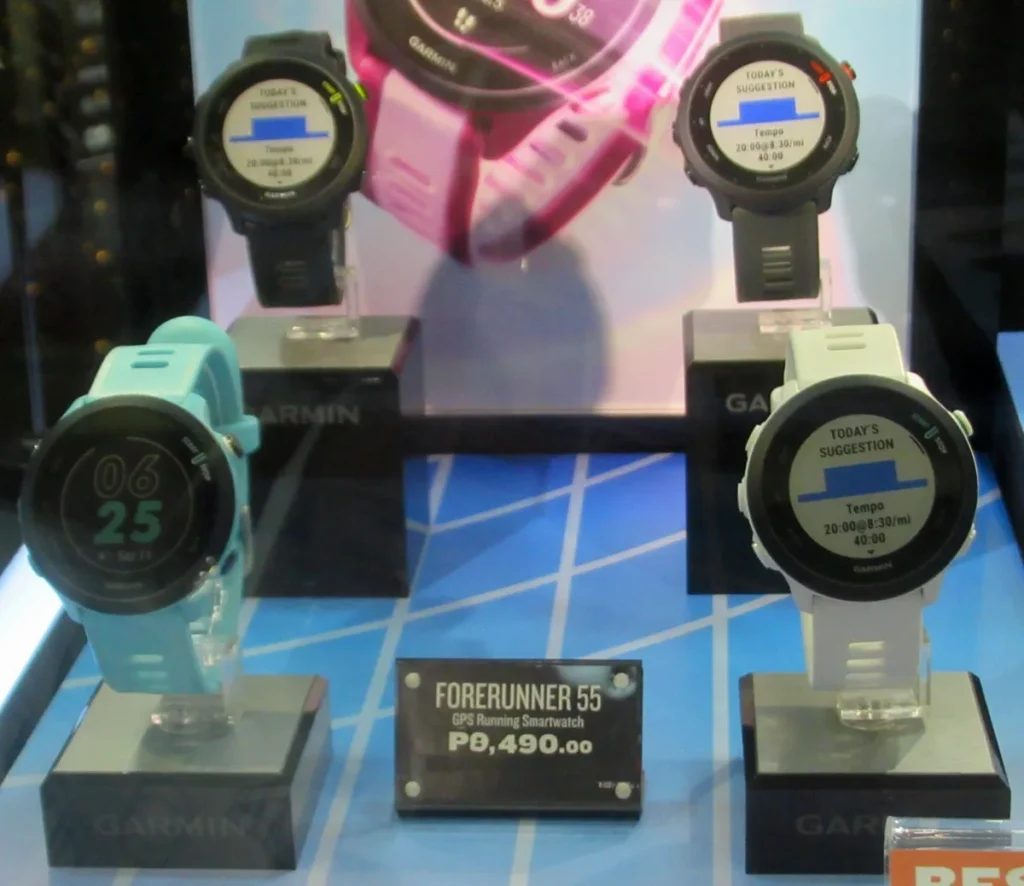
The case is 42mm across and weighs just 37g. That’s light enough to forget you’re wearing it during long runs, which matters more than it might sound when you’re 15 miles in. The silicone band is comfortable for all-day wear and comes in several colour options: black, aqua, lilac, and white.
Five physical buttons — two on the left, three on the right — control everything. There’s no touchscreen, but the button layout becomes second nature quickly. The watch face customisation is limited compared to higher-end Forerunners, but you can still set up multiple data fields to show pace, heart rate, cadence, and distance during a run.
GPS Accuracy and Tracking
The Forerunner 55 uses GPS + GLONASS for satellite positioning. For most road runners and park joggers, the accuracy is solid. Distance readings typically come within 1–2% of a known course, which is well within acceptable range.
Where the Forerunner 55 can struggle slightly is in dense urban environments with tall buildings, or on heavily wooded trails. These are conditions where even higher-end watches with multi-band GPS see some drift. At this price, with single-band GPS, the occasional hiccup is expected.
The watch also supports ANT+ sensors, so you can pair a foot pod for treadmill accuracy, a cycling cadence sensor, or even an external heart rate strap if you want better accuracy than the wrist sensor provides during high-intensity intervals.
For pace tracking, the Forerunner 55 performs well on steady-state runs. Instant pace can be jumpy at slower speeds or during acceleration, which is a characteristic of GPS-based pace rather than a flaw specific to this watch. Average lap pace is reliable and that’s usually what matters most for training.
Heart Rate Monitoring
The wrist-based heart rate sensor on the Forerunner 55 is Garmin’s Elevate sensor. It performs well at steady running paces and during daily activity. During rest, it’s reliable for resting heart rate and sleep tracking.
At high intensities — sprints, threshold work, Strava segments run hard — wrist-based HR can lag or spike. This is a physics problem inherent to optical sensors on the wrist, not a Garmin-specific issue. If your training relies on precise heart rate zones for intervals, a chest strap connected via ANT+ will serve you better. For aerobic runs, the built-in sensor is fine.
The watch also monitors heart rate variability (HRV) overnight to calculate your HRV Status, Body Battery energy level, and stress score. These metrics give a useful daily check-in on recovery, even if they’re not as sophisticated as what you get on the Garmin Forerunner 265.
Running Features
The Forerunner 55 covers all the fundamentals: pace, distance, time, cadence (with optional sensor), heart rate, and elevation. After each run, it delivers a full breakdown in Garmin Connect, including your aerobic and anaerobic training effect, lap splits, and VO2 max estimate.
Garmin’s daily suggested workouts use your recent training history and current fitness level to recommend the right effort for each day — easy run, tempo session, or rest. It’s a genuinely useful feature that’s usually reserved for more expensive watches.
Race predictor estimates your times across common distances based on your VO2 max. These tend to be optimistic for newer runners but become more accurate as you log more miles. Pace alerts let you set upper and lower boundaries so the watch vibrates if you drift out of target pace range on a run.
What’s missing compared to the Forerunner 265 and above: running dynamics (ground contact time, vertical oscillation), training readiness score, and multi-band GPS. If you want those, you’ll need to step up in budget. For most beginner to intermediate runners, the Forerunner 55 covers what you’ll actually use.
Battery Life
Garmin rates the Forerunner 55 at 14 days in smartwatch mode and 20 hours in GPS mode. In real-world testing, most people get 10–12 days with the watch on all day and two or three GPS-tracked runs per week. That’s still exceptional for a GPS running watch at this price.
Compare that to the Apple Watch SE, which lasts around 18 hours on a single charge and needs nightly charging. The Forerunner 55 comfortably covers a week of heavy training without reaching for the charger. For anyone training for a marathon with long weekend runs, 20 hours of GPS is enough for all but the most extreme ultra-marathon training.
Smart Features and App
The Forerunner 55 handles basic smartwatch functions: notifications from your phone, weather, Calendar integration, and alarm setting. It won’t replace your phone on your wrist — there’s no music storage or Garmin Pay — but it keeps you informed during the day without needing to pull your phone out.
Garmin Connect, the companion app, is comprehensive and free. It syncs automatically over Bluetooth and stores your full training history. The app is well-regarded by athletes and shows your run data, sleep analysis, body battery, stress tracking, and health snapshots.
Garmin also integrates with Strava, TrainingPeaks, Apple Health, and Google Fit, so your runs flow into whatever ecosystem you prefer. The only friction: initial setup takes a few minutes to link third-party apps, but it’s a one-time task.
Garmin Forerunner 55 vs the Competition
At this price point, the main competitors are the Polar Pacer, the Coros Pace 3, and the previous-generation Garmin Forerunner 45.
The Coros Pace 3 is arguably the strongest alternative. It has a longer GPS battery (38 hours), multi-band GPS option, and similar tracking features. It costs about the same. The tradeoff: Garmin’s ecosystem, daily suggested workouts, and Body Battery are better integrated.
The Polar Pacer is similarly priced and excellent for running metrics, with detailed training load analysis. Garmin’s overall smartwatch experience is smoother, and the Forerunner 55’s battery is competitive.
Within the Garmin range, the step up to the Forerunner 265 costs roughly $100–$150 more and brings an AMOLED display, multi-band GPS, running dynamics, training readiness, and music storage. If those features matter to you, they’re worth the extra. If you’re just starting out or want a reliable everyday tracker, the FR55 is the smarter starting point.
For women who want a smaller option, the best Garmin watches for women guide covers the full range including smaller and lighter alternatives. The Forerunner 55 itself is unisex, but its 42mm case might feel large on smaller wrists.
If you’re unsure whether a running-focused Forerunner is right or whether a more all-round smartwatch like the Garmin Vivoactive 5 suits you better, that comes down to whether running is your primary activity or one of many.
Who Should Buy the Garmin Forerunner 55?
The Forerunner 55 is at its best for:
- New runners who want proper GPS tracking without overpaying
- Casual runners doing 20–40 miles a week who don’t need advanced training metrics
- Anyone moving up from a fitness band or phone-based tracking
- Budget-conscious athletes who want Garmin’s ecosystem without the Forerunner 265 price
- Travellers and commuters who need a long-battery GPS watch
It’s not the right choice if you’re training for a sub-3:30 marathon with structured intervals and want precise heart rate zone tracking — a chest strap and the Forerunner 265 would serve you better. And if you need maps, music, or contactless payments from your running watch, you’ll need to look higher up the range.
See our guide to Garmin Forerunner vs Fenix if you’re trying to decide whether a Fenix makes more sense for your goals.
Verdict
The Garmin Forerunner 55 is a well-built, reliable GPS running watch that gets the fundamentals right. GPS tracking is accurate, battery life is excellent, and Garmin Connect gives you a complete picture of your training. The daily suggested workouts alone are a feature many people expect to pay more for.
At around $149–$169 (and sometimes lower on sale), it delivers genuine value. If you’re a new or casual runner who wants a proper running watch rather than a fitness band, this is the natural place to start in Garmin’s lineup.
FAQ
Is the Garmin Forerunner 55 good for beginners?
Yes. The Forerunner 55 is one of the best entry-level GPS running watches you can buy. It’s straightforward to set up, tracks all the basics reliably, and Garmin’s daily suggested workouts give new runners structured guidance without needing a separate coaching plan. If you’re training for your first 5K or half marathon, it has everything you need.
How accurate is the GPS on the Garmin Forerunner 55?
Very accurate for road running and trails with open sky. Distance readings are typically within 1–2% of a known course. In dense urban canyons or,heavy tree cover, you may see occasional drift, which is normal for single-band GPS at this price. For most runners on most routes, the GPS performance is excellent.
Can you use the Garmin Forerunner 55 for swimming?
The Forerunner 55 is water-resistant to 5 ATM, so it’s fine for showering and swimming. However, it doesn’t have a dedicated swimming mode and won’t track swim metrics like laps, SWOLF score, or stroke type. If open-water or pool swimming is part of your training, consider the Garmin Forerunner 255 or higher.
Does the Garmin Forerunner 55 work without a phone?
Yes. The Forerunner 55 has onboard GPS, so it tracks runs independently without a phone. You’ll need a phone nearby to sync data to Garmin Connect, receive notifications, and push workouts, but for the actual run, the watch operates entirely standalone.
How long does the Garmin Forerunner 55 battery last?
Garmin rates the battery at 14 days in smartwatch mode and 20 hours with GPS active. Real-world smartwatch battery life for most users is 10–12 days depending on notification volume and GPS usage. That’s far longer than most smartwatches, and enough to cover a week of daily runs plus a long run without charging.
What’s the difference between the Garmin Forerunner 55 and 265?
The Forerunner 265 costs roughly $100–$150 more and adds an AMOLED touchscreen display, multi-band GPS for better accuracy in tricky conditions, running dynamics metrics, training readiness score, and music storage. For serious runners who train by heart rate zones or want navigation features, the step up is worth it. For beginners or casual runners, the Forerunner 55 covers everything you’ll actually use.
Sources
- Garmin Forerunner 55 Official Product Page
- Garmin Forerunner 55 Owner’s Manual
- Featured image: Melyanac, CC0, via Wikimedia Commons
- Inline image: Garmin Filipinas, CC BY-SA 4.0, via Wikimedia Commons